

Human Resource Management Course | HR Career Path and 10 Top Skills
13 min read
Human resource management has evolved significantly over the last decade. HR no longer serves only administrative needs or policy enforcement; instead, it plays a greater role in workforce planning, employee development, culture change management, retention, organisational transformation efforts, and business performance evaluation. This shift has made human resource management an even more visible, strategic, and influential function within modern business.
As expectations of human resource professionals have evolved, so too have their expectations. Employers increasingly look for individuals capable of more than managing routine processes – they require individuals who can communicate effectively, manage sensitive matters with sound judgement, support managers, interpret workforce data accurately and contribute towards wider organisational goals. Simply put: the modern human resources function requires a broader skill set, enhanced management judgement, and greater commercial insight into how people decisions affect business results.
HR careers have become more varied over time, as evidenced by their increasing diversity. Many professionals begin in entry-level support roles before transitioning into generalist or leadership roles; others specialise in areas such as learning and development, rewards, employee experience management, or HR analytics. HR careers tend to be flexible rather than fixed, making this field attractive to professionals with diverse strengths, interests and long-term career objectives.
Career progression in HR depends on capability. Practical experience remains vital; however, structured learning can boost confidence and accelerate development. A human resource management course is an ideal way for individuals to build core professional knowledge. Other courses, such as online HR training and HR analytics courses, offer broader development or targeted specialisation options. Professionals planning long-term careers in human resource management must fully understand the available options and the required skills.
This blog examines the HR career journey from entry-level to executive leadership, the top human resource management skills every professional requires, and how appropriate learning choices support their development at each step. Furthermore, this article discusses how HR management courses and structured development can help professionals build the practical skills, confidence, and strategic perspective necessary for success in the modern workplace.
Key Takeaways
- HR offers multiple career paths, from entry-level support roles to executive leadership.
- Modern HR success depends on people skills, business awareness, digital confidence, and ethical judgement.
- A human resource management course can support both entry into HR the profession and long-term career advancement.
- HR Courses (Online/Classroom-based), HR analytics courses, and specialist development options help professionals build broad or specialist capability.
- Long-term success in human resource management is strengthened by combining structured learning with practical experience.
Why HR Is a Strong Career Choice
HR offers varied and rewarding career opportunities
In the UK, HR remains a substantial and well-established profession. Prospects reports that approximately 476,000 people work in HR roles across the country, and the profession has grown four times faster than the UK workforce as a whole over the past decade. Salary data also indicates strong progression opportunities: HR officers typically earn £30,681 to £51,800, rising to £35,923 to £60,650 with experience, while senior HR managers, business partners, and directors can earn significantly more.
This growth reflects a broader reality as organisations across every sector now depend on skilled HR professionals to meet strategic priorities, manage talent, and navigate complex workplace challenges.
HR careers now go beyond administration
The role of HR has shifted. What was once centred on paperwork, policy enforcement, and compliance now includes workforce strategy, leadership development, employee experience, organisational design, organisational change, and people data. Modern human resource management increasingly includes HR practices that shape culture, improve employee engagement, and strengthen organisational performance.
This evolution has made HR more intellectually demanding and professionally diverse. Today’s HR professionals are expected to advise leaders, influence culture, support change management, and use data and insights to make stronger people decisions. They may also contribute to areas such as job analysis, job evaluation, labour relations, benefits administration, and the wider training and development function.
That is why structured development matters. A human resource management course does more than provide theory. It helps professionals understand how human resource management connects to performance, capability, and organisational effectiveness in real organisations.
Who may be well-suited to a career in HR?
HR often suits professionals who combine strong interpersonal skills with sound judgement, an interest in business, and a commitment to fairness. The profession requires the ability to manage relationships, balance competing perspectives, and handle sensitive situations with care. Strong communication, discretion, and conflict resolution matter just as much as process knowledge.
There is no single route into the profession. Human resource management attracts people from business, law, education, operations, and psychology. Some come from organisational or industrial-organisational psychology, where understanding behaviour and workplace performance is already central. Others move into HR after gaining experience in customer service, administration, or team supervision.
What matters most is not one specific background but rather a willingness to build the right human resource management skills, practical judgement, and professional credibility over time.
HR Career Path: From Entry-Level to Leadership
The HR career path is broader than many people expect. Some professionals gain broad experience across the employee lifecycle, becoming senior generalists. Others specialise early in areas such as talent acquisition, reward, performance management, or HR analytics. Some move steadily into leadership, while others follow a more non-linear path shaped by projects, sector changes, or evolving strengths.
At every stage, progression depends on capability. The combination of structured learning, workplace exposure, and growing confidence in handling complexity is what supports real career advancement in human resource management.

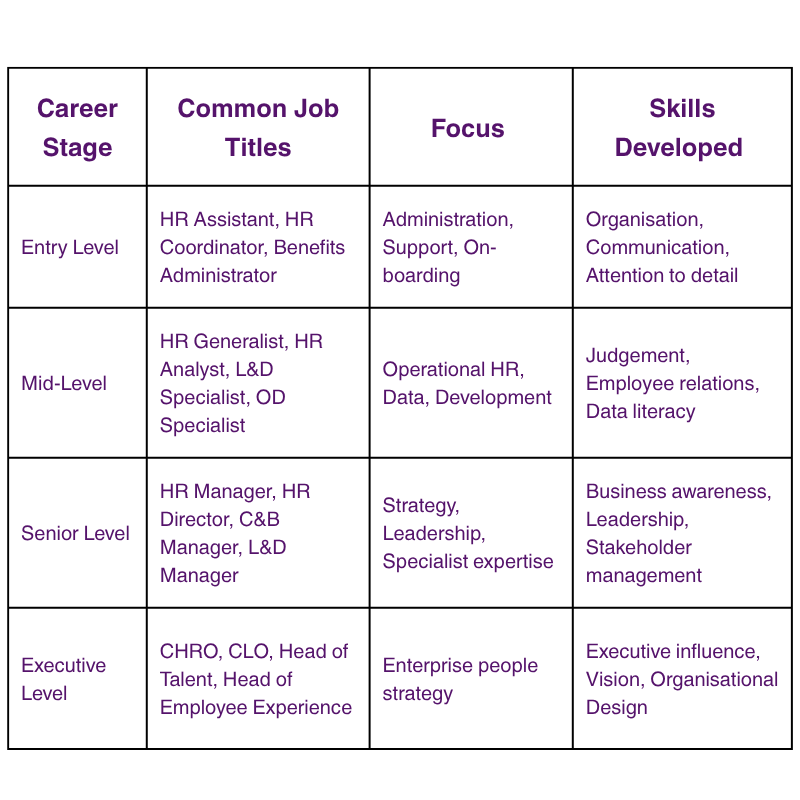
Entry-Level HR Roles
Most HR careers begin in support-focused positions. Common entry-level titles include:
- HR Assistant — supports day-to-day HR administration, handles correspondence, and maintains employee records.
- HR Coordinator — manages scheduling, onboarding logistics, and early-stage recruitment processes.
- Benefits Administrator — assists with the administration of employee benefits programmes and queries.
These roles build foundational knowledge and expose professionals to the full scope of human resource management operations. They also help early-career professionals develop core practical skills in organisation, communication, systems use, and process coordination.
Mid-Level HR Roles
From entry-level, professionals typically progress into roles that carry more breadth and responsibility:
- HR Generalist — manages a range of HR functions across the employee lifecycle.
- Learning and Development Specialist — designs and delivers training and development programmes.
- HR Analyst — uses data, systems, and reporting tools to support workforce decisions.
- Organisational Development (OD) Specialist — focuses on culture, change, and organisational effectiveness.
At this stage, professionals often deepen their knowledge, improve their judgement, and gain exposure to wider HR practices. This is also the point where professionals often begin clarifying whether they want a generalist route or a specialist path.
Senior HR Roles
Senior-level positions require a combination of strategic thinking, technical expertise, and leadership capability:
- HR Manager — leads HR operations for a team, department, or business unit.
- Compensation and Benefits Manager — oversees pay structures, reward design, and benefits strategy.
- Learning and Development Manager — manages the broader L&D function and aligns it with organisational goals.
- HR Director — provides strategic direction across the HR function and partners with senior business leaders.
At this level, business strategy, stakeholder management, and commercial judgement become more important. Professionals are expected to understand not only HR delivery, but also how people decisions affect the wider organisation.
Executive HR Roles
At the executive level, HR professionals shape organisation-wide people strategy:
- Chief Human Resources Officer (CHRO) — leads the full people function at the board or executive level.
- Chief Learning Officer (CLO) — drives organisational learning and capability at an enterprise level.
- Head of Talent Management — leads enterprise-wide talent strategy, succession planning, and pipeline development.
- Head of Employee Experience — shapes how employees experience the organisation at every stage of their journey.
At this level, success depends on executive influence, strategic judgement, deep understanding of the workforce, and the ability to link human resource management to long-term business priorities.
HR Career Path Table
Real-World HR Career Path Examples
1. Generalist to Leadership Path
HR Assistant → HR Coordinator → HR Generalist → HR Manager → HR Director → CHRO
This is one of the most common HR careers. Broad experience across all HR functions builds the confidence, perspective, and credibility needed for senior leadership. It is often well-suited to professionals who enjoy variety, problem-solving, and working across the full employee lifecycle.
2. Learning and Development Path
HR Assistant / Coordinator → L&D Administrator → L&D Specialist → L&D Manager → Chief Learning Officer
This path suits professionals who enjoy capability building, facilitation, and organisational learning. It sits close to the training and development function and is often attractive to those who want to shape performance through learning, coaching, and the creation of strong training experiences.
3. Reward and Benefits Path
HR Assistant → HR Generalist / Reward Analyst → Compensation and Benefits Specialist → C&B Manager → Head of Reward
This route suits professionals who are strong with detail, structure, and data. It often includes work related to job evaluation, pay structures, benefits administration, and fairness in reward design.
4. Data and Analytics Path
HR Coordinator / HR Administrator → HR Analyst → People Analytics Specialist → Senior People Analyst / HR Business Partner → Head of People Analytics
As organisations invest more in workforce data, this path is becoming one of the most in-demand in the profession. Strong analytical aptitude, digital confidence, and the ability to turn data into practical recommendations are essential. Specialist HR analytics learning can be especially useful here.
5. Talent and Employee Experience Path
Recruitment Coordinator → Talent Acquisition Specialist → Talent Manager / Employee Experience Lead → Head of Talent Management / Head of Employee Experience
This path focuses on candidate and employee journeys, employer brand, and the full lifecycle experience. It is especially relevant for professionals interested in recruitment, employer reputation, employee engagement, and strategic talent management.
Generalist vs Specialist HR Path

Top 10 Essential Skills Every HR Professional Needs
Whether it’s a large or small business, HR managers are the backbone of the company. They play a vital role in improving a company’s strategy and handling most employee-related activities. They must stay up to date on various aspects, including industry policies, marketing strategies, technological and digital changes, and employee management skills.
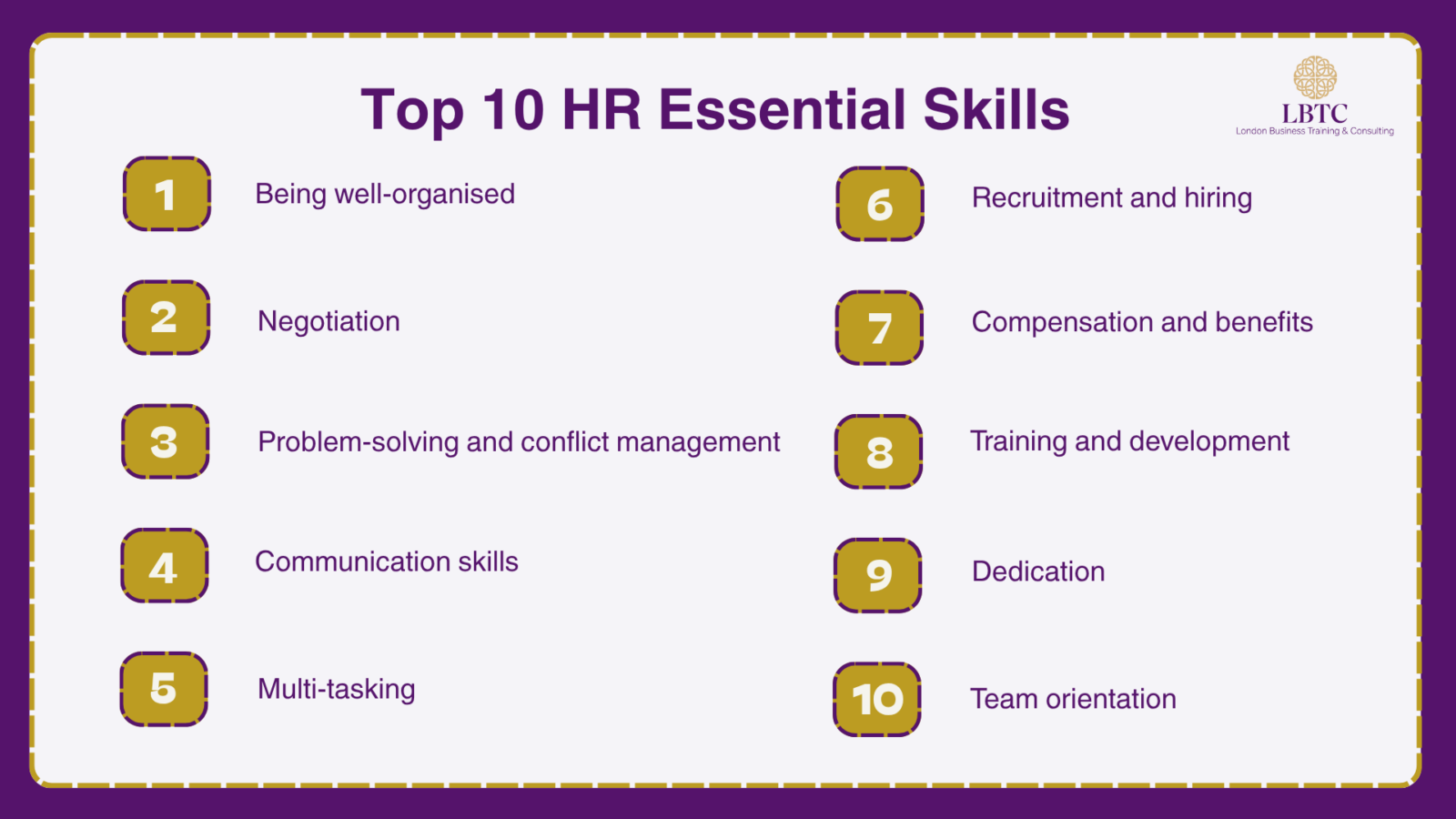
1) Being well-organised:
Being systematic and disciplined is one of the most important HRM skills. All those working in HR need to be well-organised, personally efficient, and strong at time management to succeed. This clearly states that their office cannot be in shambles. They must always file paperwork correctly, particularly in employees’ personnel files.
2) Negotiation:
Negotiation is the second most essential HRM skill. Every HR professional should be able to negotiate. Negotiating helps address many opposing viewpoints and find a middle ground acceptable to all parties. It can be said that many of the issues the HR manager faces are likely to be ‘grey areas.’ Whether negotiating salaries, resolving conflict, or securing buy-in for a new initiative, negotiation is a core HR capability. It requires both confidence and empathy.
3) Problem-solving and conflict management:
Indeed, not all employees in a company get along well with their co-workers or managers. This results in conflicts. So there’s a need to manage conflict and solve problems. It is the responsibility of a capable and effective HR manager to ensure that employees work together civilly. So that there is a quick-working situation with high-quality output.
4) Communication skills:
HR managers need excellent communication skills because they must express themselves clearly, both verbally and in writing. If HR professionals cannot communicate with upper-level managers, employees, and investors, the likelihood of a company succeeding is lower. Today, HR managers can use a variety of communication methods, such as memos, policy handbooks, and posted information. Also, HR managers need the ability to listen with empathy. They must understand the problems clearly before handling them. HR managers should also be able to handle a range of issues on and off the job.
5) Multi-tasking:
An HR manager is regularly swamped with a variety of questions, issues, and requests. Some of the issues, questions, and requests relate to others, while others might be completely different. Besides, as an HR manager, one must be able to adapt to changes in the office to be successful. Multi-tasking is essential for every HR manager, as they must handle employee issues on one side and implement new policies issued by authorities on the other.
6) Recruitment and hiring:
As you know, HR is known for recruitment and hiring. You must have strong interpersonal and decision-making skills to be an effective hiring manager. There’s a process in place for the entire HR process, where the candidate initially meets the HR manager. Human resources leaders have to handle the interview process and hiring, so they need to present the company effectively. Moreover, they must possess the skill to identify best practices processes so that competing candidates can be evaluated.
7) Compensation and benefits:
An HR professional needs to develop an effective compensation system and benefit structures while working with management. They must be able to acquire new talents and retain them in the organisation by accurately framing the benefits and compensation. Moreover, the HR manager should possess analytical, negotiation, and problem-solving skills to provide packages in line with industry norms.
8) Training and development:
Training and development in human resource management is another important asset. HR managers should possess presentation abilities and instructional skills. Also, they need the capability to develop the best training programs that deliver tangible results and significant benefits to the organisation.
9) Dedication:
HR managers should have the skills to assist, coach, and develop the employees. Their main intention must be remediation, continuous development, and innovation. To improve HR functions, HR professionals now use technology and stay up to date. HR management can leverage a range of competencies, including human resource information systems, applicant tracking software, data analysis, and more.
10) Team orientation:
To become a perfect HR manager, one must have resource and talent planning. HR management should implement a comprehensive reward system that aligns experiences, skills, and rewards appropriately. Moreover, they should be able to build a positive relationship with employees in the workplace. HR managers must understand team dynamics and work to bring disparate individuals together and foster teamwork.
Whether it’s a large or small business, HR managers are the backbone of the company. HR professionals play an integral role in developing and overseeing company strategies and managing employee-related activities. HR professionals must stay current on topics including industry policies, marketing strategies, technological and digital developments, and employee management skills to remain effective in their roles. However, if you want to be more successful in your field, opt for a human resource management course that offers a broader range of knowledge. You will be prepared to handle difficult staff members, consider the influence of unions and government on personnel, and, most importantly, manage payment structures.
5 Steps to Build a Successful HR Career
Step 1. Build a strong foundation
Start with the core knowledge areas such as employment law, recruitment, performance management, employee relations, and the structure of the HR function. A human resource management course provides this foundation in a structured, credible format.
Step 2. Gain practical workplace experience
Knowledge without application has limited value. Seek out projects, secondments, or responsibilities that expose you to different parts of HR. Gaining practical experience accelerates confidence and professional judgement.
Step 3. Develop both people skills and business skills
Professionals who are strong with people but weak in business, or vice versa, may find progression harder. Invest deliberately in both. Business acumen and commercial awareness are now core expectations for mid-level and senior HR roles.
Step 4. Decide whether to stay broad or specialise
This decision does not have to be permanent, but having a direction helps. Generalist routes offer range and versatility. Specialist careers offer depth and recognised expertise. Most professionals find clarity on this point by their third or fourth year in the profession.
Step 5. Keep learning as HR evolves
HR is not a static profession. Technology, regulation, workforce expectations, and organisational priorities continue to change in response to emerging trends. Professionals who invest in continuous learning through HR courses, professional networks, practical reflection, and practice help professionals stay relevant and competitive throughout their careers.
Questions to Ask Yourself Before Choosing an HR Career Path
1. What kind of HR work interests you most?
Do you find yourself drawn to recruitment, development, data, employee wellbeing, or organisational change? Your natural interests are often a reliable indicator of where you will perform best.
2. Do you prefer broad responsibility or specialist depth?
Some professionals enjoy variety. Others prefer technical depth. Neither is superior; both lead to rewarding careers. The right choice depends on how you work best and the impact you want to have.
3. Do you want to work closely with employees, managers, or business leaders?
Some HR roles are primarily employee-facing. Others involve frequent collaboration with senior leaders on strategic priorities. Knowing which environment energises you helps clarify the right direction.
4. Which skills do you already have, and which do you need to build?
An honest skills audit is a useful starting point for any development plan. Map your current strengths against the skills outlined earlier in this blog, and identify the gaps that an HR course or structured experience could help close.
Take the Next Step in Your HR Career
Human resource management offers flexible, rewarding, and long-term career opportunities for professionals who are willing to develop both their knowledge and their practice. The profession increasingly rewards those who invest in continuous learning, build real workplace capability, and stay responsive to organisational needs.
A human resource management course provides the structured foundation that many professionals need, whether they are entering the profession or preparing for broader responsibility. Specialist HR courses, online HR courses, and HR analytics learning can help professionals deepen their expertise in areas such as talent acquisition, employee relations, training and development, and data-informed decision-making.
Across every specialism, long-term success comes from combining structured learning with practical experience, reflection, and a willingness to keep building new skills. That is what separates professionals who stagnate from those who progress.
If you are ready to invest in your HR career, explore our range of HR courses, online courses, and specialist learning options designed for working professionals at every stage of the career path.
Frequently Asked Questions
1. Is HR a good long-term career choice?
Yes. Human resource management offers clear progression routes, transferable skills and opportunities across sectors. As organisations place greater importance on culture, capability, compliance, and performance management, the value of HR expertise that supports these areas remains high.
2. What is the usual entry point into HR?
Many professionals begin their HR careers as HR Assistants or Coordinators. It gives individuals exposure to administration, employee processes, and early recruitment efforts, providing a solid foundation for further development.
3. Do I need a human resource management course to work in HR?
Not always, but a human resource management course can significantly strengthen your preparation. An HR course helps build core knowledge, supports confidence, and demonstrates commitment to professional development.
4. What skills are most important in HR?
Communication, organisational skills, ethical judgment and conflict resolution. Business awareness and data literacy remain central to this profession at all career stages.
5. Can I move from general HR into a specialist role later?
Absolutely. Many professionals begin as generalists first and then move into specialist roles once they better understand their strengths and interests. Specialist courses, targeted projects, and structured development can support that transition.